










Interested in a career in customer success? You should be. Customer success (CS) is quickly becoming one of the top career paths in B2B software – and the salaries are starting to reflect that.
In 2026, before tax and without including bonuses or stock, the global median baseline salary for a Customer Success Manager (CSM) is $70,500. Add bonuses, stock, and commission into the picture, and the median total compensation climbs to $75,500.
That headline number doesn't tell you everything, though. Geography, gender, experience, industry, company size, and even how heavily you use AI all push the figure up or down.
What do American CSMs get paid? Which countries pay the best once you factor in the cost of living? Is the gender pay gap closing? And why do 72% of CSMs say their salary doesn't reflect what the role actually entails?
Customer Success Manager salaries across the globe
CSMs work tirelessly to help clients maximize the value of their products and achieve their goals. Given the business impact of their work, salaries should reflect that value. In practice, earning potential varies dramatically depending on where you live and work – salaries in Atlanta look nothing like salaries in Amsterdam.
It's worth bearing this in mind as you read on, especially if you're thinking of relocating for your next role.
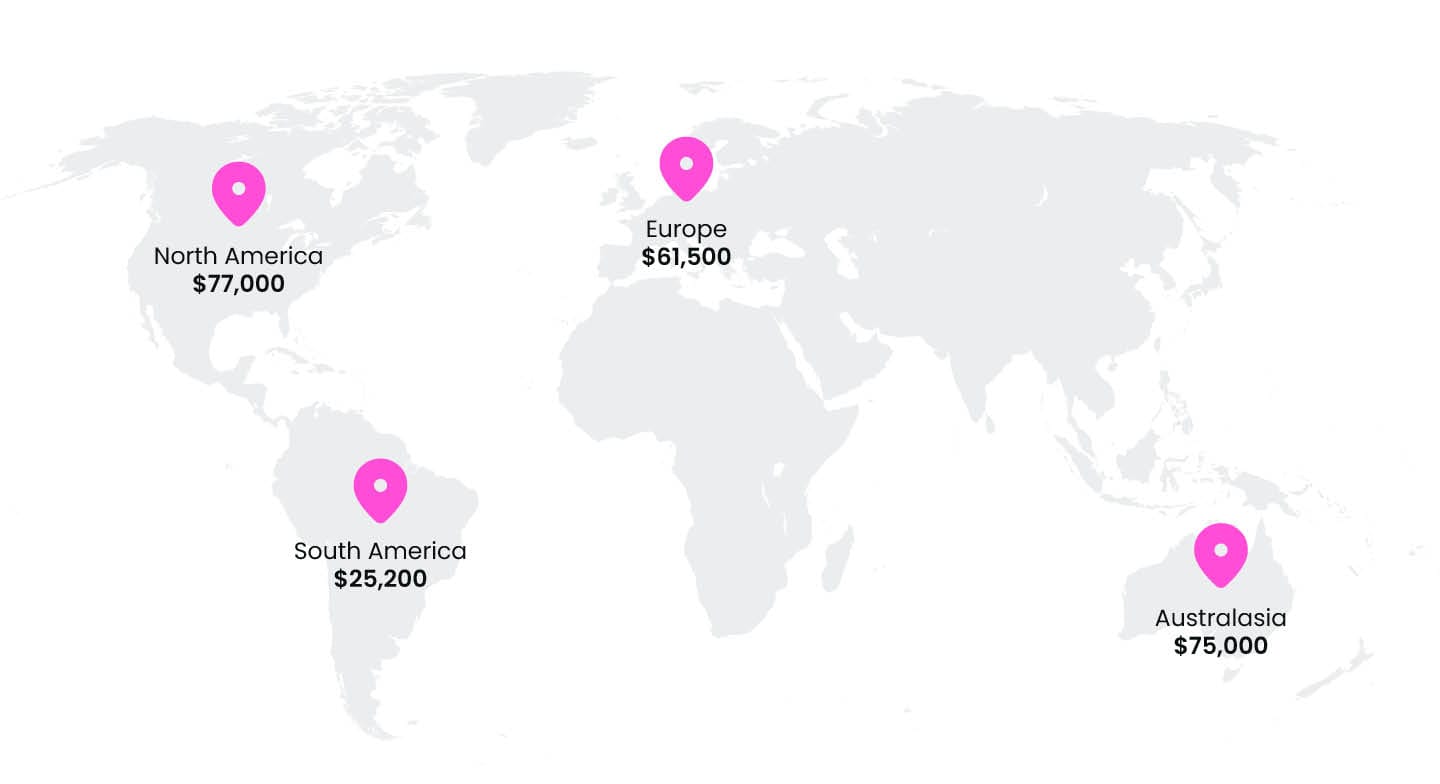
- In Australasia, a Customer Success Manager earns 6.4% more than the global median salary.
- In South America, a Customer Success Manager earns 64.3% less than the global median salary – a reflection of regional pay norms and cost of living rather than the calibre of the talent.
- In North America, a Customer Success Manager earns 9.2% more than the global median salary.
- In Europe, a Customer Success Manager earns 12.8% less than the global median salary.
How much do Customer Success Managers earn by country?
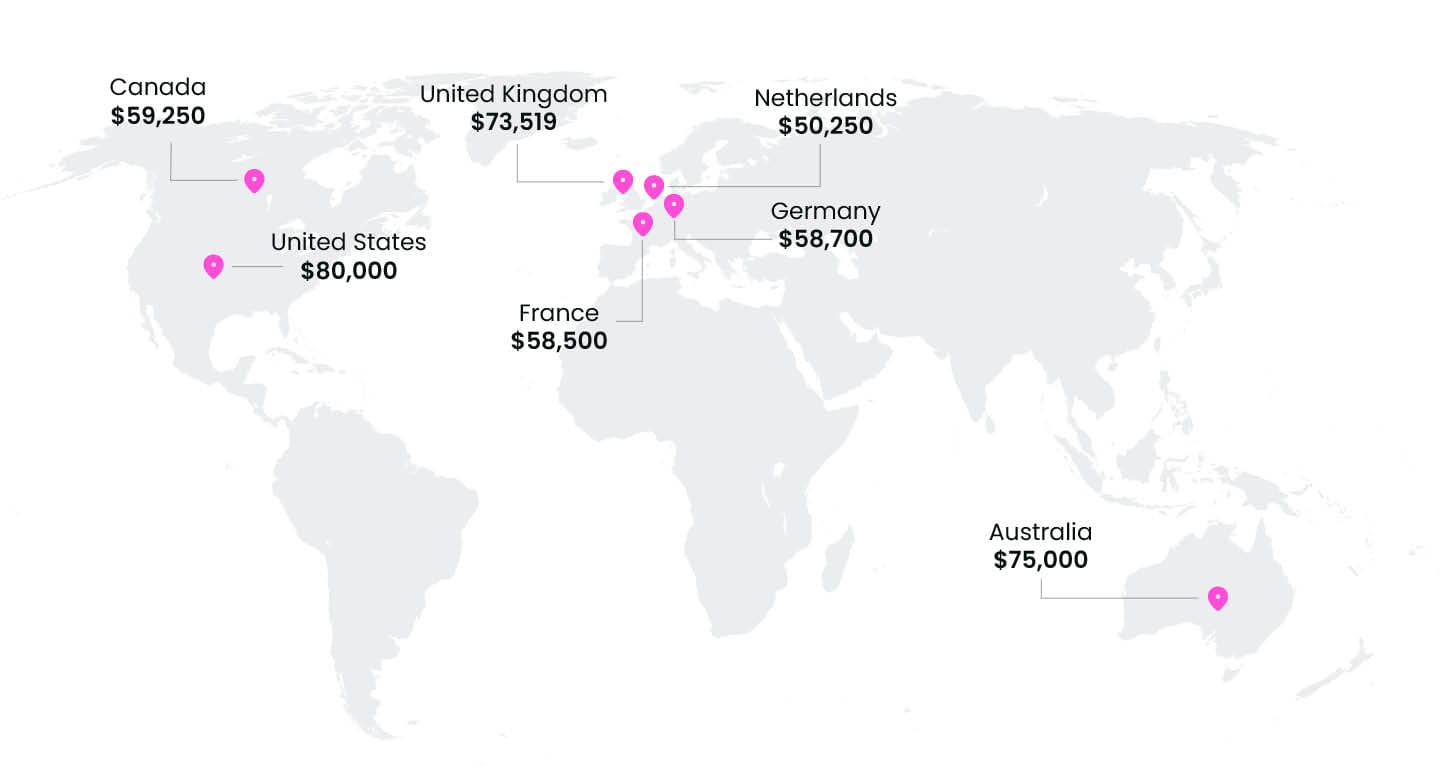
The story between 2024 and 2026 is one of mild compression at the top and notable strengthening in the UK. American CSMs still earn the highest medians of any major country in the sample, but the gap to the UK has narrowed from a 29-point deficit to roughly 9 points. Continental Europe – France, Germany, the Netherlands – sits in a tight band around the $50,000–$60,000 mark.
Why include PPP (purchasing power parity) in salary analysis?
Salaries alone don't tell the full story. The cost of living and purchasing power of a dollar (or euro, or pound) varies enormously between countries. A CSM on $75,000 in Berlin lives a very different financial life to a CSM on the same $75,000 in San Francisco.
Including purchasing power parity (PPP) in salary analysis adjusts for those differences, offering a clearer view of the real-world value of earnings.
*Source: OECD / World Bank
What is PPP and why does it matter?
PPP adjusts salaries to account for the differences in cost of living across regions, showing how much a salary can actually buy in local goods and services. A higher PPP-adjusted salary means greater financial comfort and purchasing power in that region – not just a bigger number on the payslip.
For example, the UK's median CSM salary of $73,520 (£55,000-ish) is just 4.3% above the global median in raw dollar terms. But the UK has high housing and consumer costs, especially in London and the South East, which erodes that headline. A US-based CSM on $80,000 will, in most metros outside the major coastal cities, see substantially more spending power than a UK CSM on a similar nominal figure.
PPP reveals true earning potential by adjusting for the regional cost of living. For companies, PPP makes equitable global pay possible; for professionals, it sharpens the maths on relocation and remote-offer decisions.
Source: OECD / World Bank
CSM salary adjusted for cost of living by metro area
Country-level data gives you a broad benchmark – but it's the metro or city-level numbers that really shape your day-to-day reality, especially if you're considering a move or negotiating a remote offer.
Cost of living can swing dramatically between cities, even within the same country. Take the San Francisco Bay Area and New York City. Median CSM base salaries in San Francisco still sit comfortably above $115,000 in 2026; New York City lands closer to $105,000. But once you adjust for housing, transport, and everyday expenses, San Francisco's premium shrinks fast. A CSM earning $90,000 in Austin or Denver often has comparable take-home comfort to a $120,000 earner in the Bay.
The same pattern holds in Europe.
London CSMs typically earn £60,000–£75,000, but steep rents and daily expenses mean their purchasing power is broadly on par with Berlin-based CSMs earning €55,000–€65,000. Berlin's lower cost of living can make a slightly lower salary stretch further – often translating into a higher quality of life for the same role.
TL;DR: Don't just look at the headline salary
Use cost-of-living calculators or city-specific indices to compare offers properly.
We've seen CSMs relocate from high-cost metros to mid-tier cities and either maintain or improve their standard of living, despite a nominal pay cut. The real value is what your salary buys you – not the number on your contract.
If you'd like to know what other CS job titles earn per annum, be it Head, VP, or Director of Customer Success, you'll find that intel and more in the 2026 Customer Success Salary Report.
How much does a Customer Success Manager earn in the United States of America?
In the Customer Success Salary Report 2025/26, more than four in ten of our CSM respondents hailed from the United States – the largest country-level cohort in the dataset.
In the US, the median baseline salary for a CSM (before tax) is $80,000.
To provide a comprehensive view of US CSM salaries, we analysed regional trends. This approach captures broader compensation patterns where state-level data is too thin, offering a more representative picture of CSM pay nationwide.
Regional salary breakdown
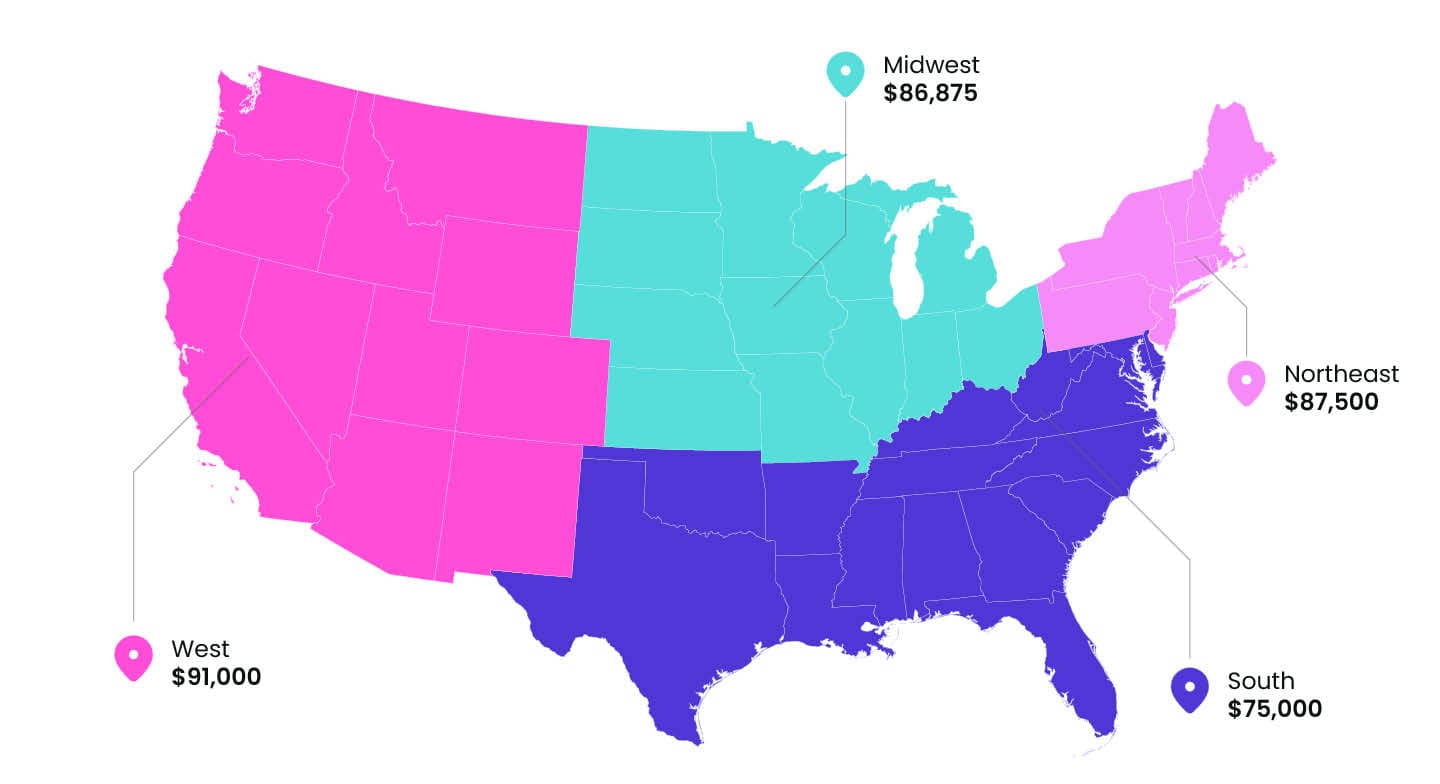
- West: Leads the country at $91,000, 29.1% above the global median. The Bay Area, Seattle, and LA continue to anchor the top end of US CSM pay.
- Northeast: Median of $87,500, comfortably ahead of the global median by 24.1% and a touch above the US average.
- Midwest: Median salary of $86,875 – well above the global median and slightly above the US average. A notable jump from previous years and a sign that tech-adjacent industries in Chicago, Minneapolis, and Detroit are pulling CSM compensation upward.
- South: $75,000, exactly matching the global median. The South's premium over previous reports has compressed as remote work flattens regional differentials.
Key insights
- The West reclaims the top spot. After a few years of the South leading on median CSM pay, the West is back in front – driven by sustained demand in the Bay Area and Pacific Northwest tech sectors.
- The South's lead has eroded. Remote-first hiring has narrowed the geographic premium that southern tech hubs (Austin, Atlanta, Raleigh) enjoyed during the post-2020 boom.
- Midwest and Northeast are converging. Both now sit firmly in the high $80,000s – a tighter band than the 2024 data showed.
Customer Success Manager salaries by US state
Wanting to take a more granular look, we examined CSM salaries on a state-by-state basis. The samples are smaller, so treat these as indicative rather than definitive.
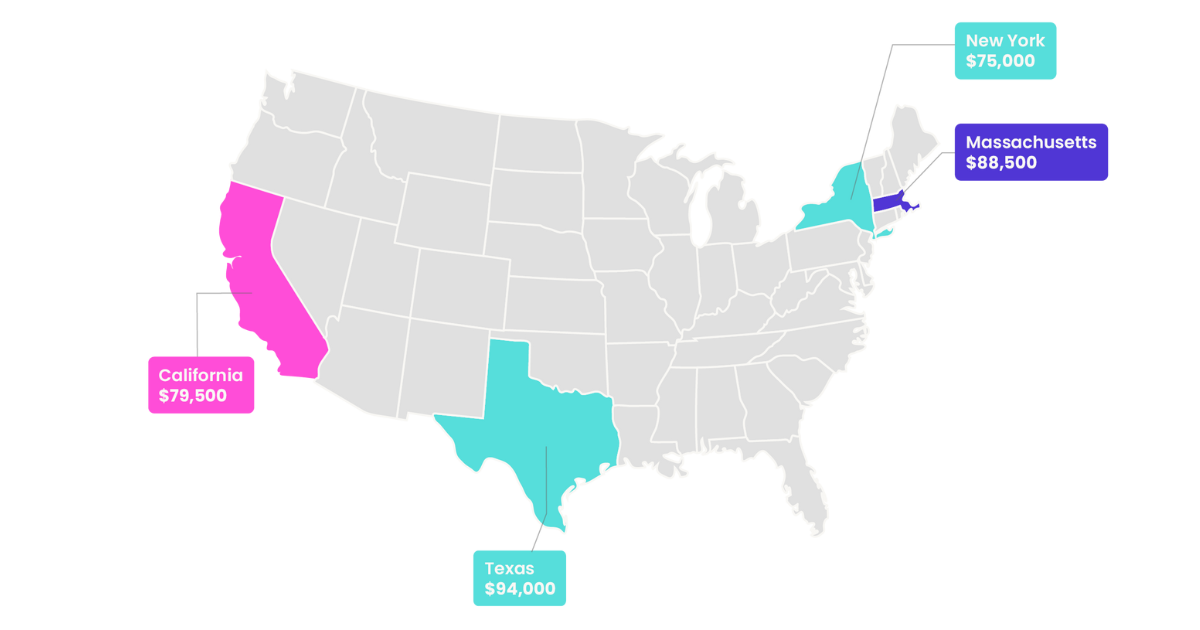
- In Illinois, a CSM earns 30.1% more than the global median – the highest in our state-level sample – and 14.7% more than the US median.
- In California, a CSM earns 29.4% more than the global median and 14.1% more than the US median.
- In Texas, a CSM earns 6.4% more than the global median but 6.3% less than the US median, a meaningful softening from the 2024 picture where Texas led the country.
- In Michigan, a CSM earns 14.9% more than the global median and roughly matches the US median.
US CSM salary differences: Tier 1 vs. tier 2 tech cities
When you're weighing job offers or planning your next move, the salary landscape between tier 1 and tier 2 tech cities can be a game-changer.
Tier 1 tech cities – San Francisco, New York, Seattle, Boston – are established hubs with deep talent pools and a concentration of high-growth companies.
Tier 2 cities, such as Austin, Denver, Atlanta, and Raleigh, are fast-emerging tech centres offering strong opportunities with slightly less competition and lower living costs.
So what's the real salary difference?
CSMs in tier 1 cities typically command a 15–25% premium over their counterparts in tier 2 markets. A mid-level CSM in San Francisco might see offers in the $115,000–$130,000 range, while the same role in Austin or Denver lands closer to $90,000–$105,000.
But here's the kicker: once you factor in the cost of living, the gap narrows considerably. Housing, taxes, and daily expenses in tier 1 cities can erode much of that headline premium.
The trade-offs go beyond money, too. Tier 1 markets often offer faster career progression, exposure to larger enterprise clients, and more robust professional networks. Tier 2 cities tend to deliver better work-life balance, lower burnout risk, and increasingly competitive remote or hybrid arrangements.
Ambitious CSMs thrive in both settings – some prioritise salary and career acceleration, others value quality of life and flexibility. The best choice depends on your goals, but understanding the dynamics puts you in the driver's seat.
CSM total compensation: Base, bonus, stock and commission
If you're evaluating a job offer or benchmarking your current package, base salary is only half the picture. Most Customer Success Manager roles carry a meaningful variable component – bonus, stock, or commission tied to renewals and expansion – and these can swing total compensation by tens of thousands of dollars.
Here's how the full compensation picture breaks down for a CSM in 2026:
A few takeaways for offer evaluation:
- Bonus is the most common variable lever. Just over two-thirds of CSMs receive one, and the median is around $10,000. If your offer doesn't include one, that's worth pushing on.
- Stock is the exception, not the rule. Only 15.8% of CSMs receive equity, and median grants among those who do are modest. If you're moving from a stock-heavy startup to a more established company, expect bonus to do most of the variable-comp work instead.
- Commission is increasingly common. 44.7% of CSMs now earn commission on upsell, cross-sell, or renewals – a clear signal that the CSM role is being treated as a revenue function, not a support function. If your role includes expansion targets, commission should be part of the deal.
- The base-to-total spread is roughly $5,000 at the median. That's smaller than it sounds, because not every CSM receives every component. The gap widens significantly at the top end – high-performing CSMs at well-resourced companies can see total comp $20,000–$40,000 above base.
When evaluating offers, always ask for the full breakdown: base, target bonus, equity grant (and vesting schedule), and commission structure. A $75,000 base with a $15,000 target bonus and a real commission plan is a meaningfully better package than $80,000 base with nothing else attached.
CSM total compensation by region
The same geographic patterns that shape base salary show up in total comp – North American CSMs lead, European CSMs trail by roughly 23%.
Customer Success Manager salary by industry vertical
The industry you work in shapes your CSM salary almost as much as where you live. Tech-adjacent verticals dominate the CS hiring market, but salaries vary meaningfully across them.
A few things worth flagging:
- HR tech pays the most in our 2025/26 sample. Vendors selling into HR functions (HRIS, talent, learning, payroll) command a 16% premium over the global CSM median. The combination of long sales cycles, high renewal stakes, and complex stakeholder maps makes experienced CSMs valuable.
- E-learning sits 5% above the global median. Strong demand for CSMs in this space, particularly post-pandemic as enterprise L&D spending grew.
- IT & Services and Computer Software – the two largest CSM employers – sit at or slightly below the global median. This is the tech-baseline rate for the role. If you're a CSM at a SaaS company earning meaningfully more than this, you're either at a well-funded enterprise vendor or in a senior IC role.
Company size and revenue: the biggest CSM salary driver
Reddit threads and CS hiring managers consistently flag company size and revenue stage as the single biggest determinant of CSM compensation – bigger than geography, bigger than years of experience, sometimes bigger than seniority of title.
Our data backs that up.
CSM salary by company revenue (ARR proxy)
The pattern is clear: CSM salaries inflect upward once a company crosses roughly $50M in revenue. Below that line, you're typically in startup or early-scale-up territory, where companies are still building CS as a function and base salaries reflect that. Above it, you hit mature revenue stages with structured pay bands and better budget for CS hires.
CSM salary by company headcount
The employee-count picture tells a similar story:
A CSM at a 1,001–5,000-person company earns roughly $30,000 more at the median than a CSM at a sub-50-person startup. That's the largest single-variable swing in our 2025/26 dataset.
What this means for your career
- If you're optimising for base salary, target Series C / D or later. That's the band where CS pay starts pulling clear of the global median.
- If you're optimising for equity upside, accept a lower base at an earlier stage. Pre-Series-C startups pay less in cash but may grant more meaningful equity – particularly if the company hits a successful exit.
The $50M-revenue / 200-person threshold is the inflection point. If you're job-hunting and want a meaningful pay bump, this is the band to target.
Is there a gender pay gap among Customer Success Managers?
The push for greater pay transparency has been one of the most significant shifts in workplace policy over the past five years. Many organisations now run regular pay audits and publish gender pay gap data. So has CS caught up?
Not even close.
Why focus on UK and US salaries?
The overwhelming majority of our 2026 CSM respondents came from the United States and the United Kingdom. Together, those two countries account for the largest share of our data – so it makes sense to look at the gender pay gap specifically within them.
The gender pay gap in the United Kingdom
In the UK, the gender pay gap for CSMs is 25.7%, with men earning a median base salary of $94,259 compared with women's median of $70,020.
When you put that alongside broader benchmarks:
- Men's salaries in the UK CSM cohort are 33.7% above the global CSM median ($70,500) and 28.2% above the UK national CSM median ($73,520).
- Women's salaries are 0.7% below the global CSM median and 4.8% below the UK national CSM median.
This is a sharp widening from the 2024 report, which put the UK gap at 9.1%. Two things are likely at play: men in the 2026 UK CSM sample are skewed toward more senior or higher-tenure roles, and women are over-represented in earlier-career CSM positions. Either way, it's a flag for UK CS leaders to interrogate their own pay bands.
The gender pay gap in the United States
The gender pay gap for CSMs in the US stands at 31.4%, with men earning a median salary of $110,000 while women earn $75,500.
When comparing to broader benchmarks:
- Men's salaries are 37.5% above the US national CSM median ($80,000) and 56% above the global CSM median.
- Women's salaries are 5.6% below the US national CSM median but still 7.1% above the global CSM median.
The 2024 US gap was 2.8% — a number we celebrated at the time. The 2026 figure is much wider, and again, sample composition matters: men in this year's US cohort are concentrated in higher-paying companies and more senior CSM roles. But the underlying point still holds. Pay parity in the CSM role is not a solved problem. It needs structural attention from leaders, not just lip service.
What is the pay progression like in customer success?
A huge part of any job search and salary determination is experience. "Am I going to land X job at Y salary based on what I've done?" is a question every CSM should be asking themselves at performance review time.
In our 2026 survey, the average CSM has 4.2 years of experience in customer success, sitting on a median base salary of $70,500.
Upon closer examination, these trends reveal fascinating patterns:
- Early-career (1–2 years): CSMs earn a median of $59,250. This is the entry point into the profession, and salaries reflect that — but the 16% below-global figure is also a signal of how thinly companies sometimes resource their newest hires.
- Mid-career (3–4 years): Salaries climb to $69,443, very close to the global median. This is the band where most CSMs sit.
- The 5–6 year surge: Median pay jumps to $89,000 — a 28% lift on the 3–4 year band. This is where specialist CSMs (Enterprise, Strategic, Renewals) and those carrying revenue responsibility get differentiated rewards.
- 7–9 years: The dip to $74,500 reflects a familiar dynamic. Many CSMs at this tenure are moving into Senior CSM, Team Lead, or management titles — and once they do, their compensation gets counted under a different job title in the data. CSMs who stay in the IC track at 7–9 years tend to earn closer to the mid-career band than the 5–6 year peak.
- 10+ years: A bounce back to $80,000 for the small group of long-tenured CSMs who've stayed in the role rather than moving into leadership.
Key takeaways
- The biggest single jump is between 3–4 and 5–6 years. If you're approaching that mark, it's the right time to push on compensation conversations.
- Plateau risk is real. If your salary hasn't moved meaningfully between years 7 and 10, that's a signal – either to push for a title change, or to start looking.
- Mid-career (3–4 years): Salaries climb to $69,443, very close to the global median. This is the band where most CSMs sit.
- The 5–6 year surge: Median pay jumps to $89,000 — a 28% lift on the 3–4 year band. This is where specialist CSMs (Enterprise, Strategic, Renewals) and those carrying revenue responsibility get differentiated rewards.
- 7–9 years: The dip to $74,500 reflects a familiar dynamic. Many CSMs at this tenure are moving into Senior CSM, Team Lead, or management titles — and once they do, their compensation gets counted under a different job title in the data. CSMs who stay in the IC track at 7–9 years tend to earn closer to the mid-career band than the 5–6 year peak.
- 10+ years: A bounce back to $80,000 for the small group of long-tenured CSMs who've stayed in the role rather than moving into leadership.
How company maturity affects CSM salary
Company stage shapes a CSM's compensation in a slightly different way to raw company size. Two companies with the same headcount can pay very differently if one's a well-established market leader and the other's a frantic late-stage scale-up burning cash.
Two things to call out:
- Enterprise pays the most. No surprise: bigger companies, more structured pay bands, more budget for senior CSMs.
- Late-growth/scale-up sits lower than expected. This is the band where companies are scaling CSM headcount fast, often at the expense of individual base pay. The trade-off is usually equity and a faster promotion ladder — but the salary at offer time can lag.
AI adoption and the CSM salary
One of the biggest stories in CS in 2026 is (perhaps unsurprisingly) AI. We asked CSMs how heavily they're using AI in their day-to-day, and how compensation tracks against adoption.
A few things worth chewing on:
- The largest single group of CSMs are using AI for partial automation – 40.8% of the sample. Heavy AI users come in second at 31.6%.
- Light AI users earn the most. At first glance, the "exploring/light" group's $78,000 median looks counter-intuitive. Dig into the data and it makes sense – these tend to be more experienced CSMs at larger companies that are deliberate about AI rollout rather than racing to automate.
- Non-users earn the least. CSMs not using AI at all are earning 8.6% below the global median. Whether AI fluency is being rewarded directly or simply correlates with the kind of forward-leaning companies that pay better, the trend is the trend.
If you're a CSM who hasn't yet got your hands dirty with AI tooling for QBR prep, account summaries, churn-risk scoring, or onboarding workflows, the 2026 numbers are a nudge.
The compensation satisfaction crisis
Here's the stat that should give every CS leader pause. We asked CSMs two questions:
- Are you happy with your current compensation?
- Do you feel your salary is reflective of your role and everything it entails?
The answers:
- 62% of CSMs say no, they are not happy with their current compensation.
- 72% of CSMs say no, their salary does not reflect their role.
- 78% of CSMs say no, CS salaries do not reflect the business value the role adds.
That last figure is the most damning. More than three in four CSMs believe their function is under-compensated relative to the revenue impact it drives. And these are the people running renewals, expansion, churn prevention, and product adoption — arguably the most directly revenue-adjacent work in the company outside of net new sales.
If you're a CS leader reading this, the brief is clear: pay isn't just a hiring problem, it's a retention problem.
How to negotiate your Customer Success Manager salary
If you've made it this far and you're realising your salary is below the numbers in these tables, the next question is: what do you do about it? Here's the short version, drawn from how the best CSMs we work with actually run these conversations.
1. Benchmark your market rate honestly
Don't anchor to what your friends are paid or what one LinkedIn post claimed. Use the breakdown in this article — region, country, US state, industry, and company size — to calculate a realistic band for your role.
If you're a CSM at a 500-person SaaS company in the US Northeast with five years of experience, your benchmark isn't the global $70,500 median. It's the intersection of the US Northeast band ($87,500), the company-size band ($72,000–$75,000), and the experience curve ($89,000 at 5–6 years). The honest answer is "low-to-mid $80,000s."
2. Quantify your impact on retention and expansion
CS pay conversations live or die on whether you can put a dollar figure next to your work. Before walking into the meeting, line up:
- Your gross retention rate for the past 12 months, and how it compares to the company benchmark.
- Your net revenue retention (NRR) if your role includes expansion. NRR above 110% is a strong negotiating position. Above 120% and you're carrying real revenue weight.
- Specific saves and expansions you led. "I retained $480,000 of ARR in Q2 that account management had marked at-risk" is a much stronger line than "I improved retention."
- Time-on-account vs. account value. If you're managing 40 accounts averaging $50,000 ARR, that's a $2M book — make sure the company sees the number.
3. Time the ask around impact, not the calendar
Most CSMs ask at performance review time. That's fine, but it's also when every other CSM is asking, so your case has to fight for attention. Better moments:
- Immediately after a major save or expansion close: Your impact is fresh and quantified.
- After taking on additional scope: Onboarding a new product line, mentoring a new hire, owning a strategic account, leading an initiative. New scope is a clean lever.
- When a peer leaves: Companies will pay to retain proven people when they're already short-staffed.
4. Negotiate total compensation, not just base
If the company won't move on base, push on:
- Target bonus: Increasing the bonus % can deliver the equivalent of a base raise without breaking the band.
- Commission structure: if you're carrying expansion targets, the commission rate is a fair conversation.
- Equity: Particularly at growth-stage companies, additional grants are cheaper for the company than a base bump.
- Title: A title change to Senior CSM is the single biggest salary jump in the CS career ladder. If the case is there, push for it.
5. Be prepared to walk
The hardest truth: the fastest way to a meaningful pay bump in CS is to change companies.
CSMs who move jobs see larger increases than those who stay. That doesn't mean you should leave, but it does mean your current employer is more likely to make a real offer if they sense the alternative is losing you. Have a credible external benchmark (or a real conversation in your back pocket) before you walk into the meeting.
Why customer success salaries matter
"Do a job you love, and you’ll never work a day in your life." At some point, we’ve all heard this saying – and there’s a truth to it. But let’s not kid ourselves: salary plays a pivotal role in job satisfaction and career decisions.
For a business function like customer success, every ounce of a Customer Success Manager is responsible for value realization and sustained customer advocacy, generating brand and revenue growth.
In a subscription business, dependent on renewals, customer success is king. With this importance comes competitive compensation for a CSM.
Carry on your financial investigation!
If you’d like to learn more about the different factors influencing a Customer Success Manager's salary, plus take a deeper dive into more senior job titles, you can find all of this and more by downloading the Customer Success Salary Report 2025/26.
It’s the most comprehensive study into the behind-the-scenes economic action underpinning the customer success function.
You’ll love this report if you want to:
- Discover how much fellow CS professionals are earning.
- Identify your earning potential as you climb the customer success ladder.
- Verify if you’re being paid what you’re worth.
- Plan out your next career move – and decide on a suitable paycheck.


Become a CSC Insider
Thank you for subscribing
Get exclusive insights, frameworks, and strategies from customer success leaders driving real business impact.
An email has been successfully sent to confirm your subscription.
 Follow us on LinkedIn




Start the conversation
Become a member of Product Marketing Alliance to start commenting.
Sign up now