





It’s all well and good to actively seek new customers, but what happens if you ignore your current customer base? Plot twist: they churn.
In fact, 68% of customers will go elsewhere if they feel the company they’re buying from doesn’t care about their business.
Without strategically thinking about customer retention, you’re undoing all the good work invested in the pre-sales process. Retaining customers is a whole lot cheaper than recruiting new ones, plus it’s a sure way to establish long-lasting, healthy relationships that will increase metrics like your customer lifetime value (CLV) and your overall customer satisfaction score.
In fact, increasing retention by just 5% could drive your profits from 25% to 95%. It seems silly to dismiss a potential profit increase like that, right?
That’s why customer retention strategies are such an important factor when it comes to customer success.
The definiton of customer retention
Fundamentally, customer retention simply refers to a company's ability to retain its existing customers over time. In this sense, it's a valuable measure of how effective a company's customer relationship strategies are at keeping current customers satisfied and engaged.
High customer retention rates indicate that an organization is able to consistently meet or exceed customer expectations – and provide enough value to ensure that customers will continue to use its products or services.
There are several factors that influence customer retention rates. These include product or service quality, customer support, brand reputation, and loyalty programs. Companies focus on customer retention because acquiring new customers can cost more than keeping existing ones. Existing customers are also more likely to purchase more over time and provide word-of-mouth marketing.
To improve retention rates, customer success teams may collect customer feedback, address complaints quickly, offer loyalty rewards and communicate regularly to reinforce the value proposition.
But how do customer success leaders define customer retention?
This dichotomy of retention and churn is a debate examined by Rebecca Fenlon, Head of Customer Success at Cognassist. In her opinion, it’s not all that helpful to view churn and retention as opposites, with retention as the more positive way of reporting it.
“The opposite of losing customers isn’t retaining customers, it’s gaining customers, which is ultimately the realm of sales. Retention is a more proactive measure; you are constantly working towards it. Whereas churn is reactive and focused just on the point of renewal. It’s for both of these reasons that retention is our ‘one metric that matters’ more so than churn."
Rav Dhaliwal, Investor & Venture Partner at Crane Partners believes customer retention is much more than preventing revenue loss:
“[It's] the foundation on which every successful subscription software business has accelerated its revenue growth. It’s far easier to grow a sustainable business from a stable foundation of revenue than it is to try and fix retention issues as you are rapidly scaling.”
How to calculate retention rate
Like most things you invest time and energy in, it’s worth keeping track of it. And customer retention isn’t any different. You can calculate your business’ customer retention rate to gauge how many customers you’re keeping on the books.
When calculating your customer retention formula, it’s pretty straightforward but well worth jotting down:
( [E-N] / S) x 100
The "E" stands for the total number of clients at the end of your specific time period. The "N" signals the number of new customers you acquired during this period. And the "S"? This is the number of customers you started out with at the beginning of this period.
Customer retention rate formula: example
Say you own a gym. You begin Q1 with 500 members – an all-time high thanks to New Year's resolutions. After a free trial weekend promotion, 30 new members join.
Unfortunately, by the end of Q1, 50 members have left. One or two moved out of town, others lost motivation, and a few switched to different fitness routines.
You finish the quarter with 450 members. Here's how to calculate your retention rate:
- E = 450
- N = 30
- S = 500
Using the retention rate formula:
([E - N] ÷ S) × 100 = Retention rate
Let's apply it:
([480 - 30] ÷ 500) × 100 = 90
This leaves you with a retention rate of 90% – a solid result considering the typical Q1 drop-off many gyms experience after the New Year's resolution wave!

Accounting for seasonality and business cycles in retention rate calculation
When you’re measuring customer retention, it’s easy to overlook the impact of seasonality and business cycles, but these factors can significantly distort your numbers if you’re not careful.
Many businesses, especially those in retail, education, or travel, experience predictable fluctuations in customer activity throughout the year. If you compare retention rates from a peak season to a slow period without adjusting for these cycles, you risk drawing the wrong conclusions about your team’s performance.
Why does this matter? Because a dip in retention during the off-season doesn’t necessarily signal a problem with your product or service – it might just reflect normal customer behavior.
Conversely, a surge in retention during a busy period could mask underlying issues that will surface later. To get a true read on your retention health, you need to benchmark your rates against comparable periods – month-over-month, quarter-over-quarter, or year-over-year, depending on your business rhythm.
Take an online education platform as an example. If you measure retention from September to December, you’ll likely see higher rates as students are actively engaged. But those same cohorts might naturally drop off during summer months.
Don't panic, the solution is simple: compare summer retention to previous summers, not to the academic year. You can also use rolling averages or seasonal adjustment models to smooth out the data and highlight real trends. By layering in this nuance, you’ll make smarter decisions, set realistic targets, and avoid chasing ghosts in your analytics.
Cohort retention analysis and time-based segmentation
To truly understand your retention trends, it’s not enough to look at your overall retention rate. You need to see how different groups of customers behave over time – and that’s where cohort retention analysis comes in.
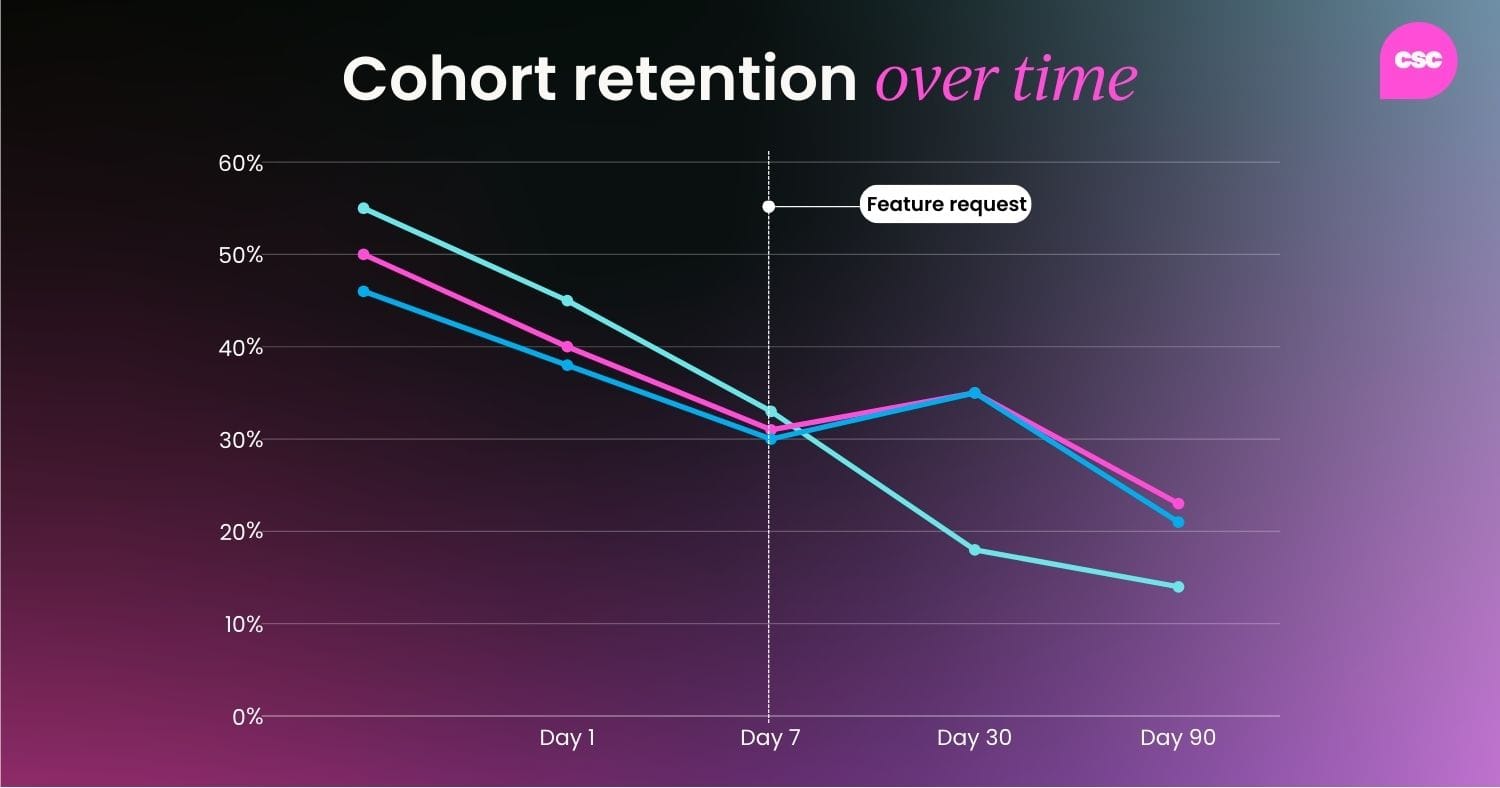
Cohort analysis lets you segment your customers based on a shared characteristic, most commonly their signup date or the moment they first engaged with a key feature. When you track each cohort’s retention curve, you begin to spot patterns that would otherwise be hidden in aggregate data.
For example, let’s say you launch a new onboarding flow in January. By grouping customers who signed up in January as one cohort, and those from February as another, you can compare how each group sticks around over the following months.
Say the January cohort retains better, you’ve got evidence that your onboarding changes worked. At Customer Success Summit Sydney 2024, Akash Singh, Global Head of Customer Success at Greensketch, revealed his experience of segmentation:
“We could group them together because they had similar choices and then we could see how they are engaging with these features. We could see patterns, behaviors. We knew when they were disengaging.”
But time-based segmentation isn’t limited to signup date. You might also cohort users by when they first used a new feature, or when they hit a specific milestone.
The key really is consistency – track each cohort’s retention at regular intervals (e.g., day 7, day 30, day 90) and visualize the results. A simple line graph showing retention rates for each cohort over time can quickly reveal whether your product changes are moving the needle. This approach empowers CS teams and analysts to pinpoint what’s working, diagnose issues, and share actionable insights with product and growth teams.
Improve your customer retention rate by identifying the cause of churn
You can get ahead of future cases of churn by establishing what went wrong in the first place. Figuring out exactly why clients left your business is a pragmatic, proactive way of avoiding history repeating itself.
If people are choosing your competitor’s product over your own, and you’re still none the wiser after your market research, it’s time to go straight to the horse’s mouth. Asking your customers what went wrong is a straightforward way to avoid repeating the same mistakes.
Your product might be great, with all the bells and whistles to push you in the direction of the market leader, but poor customer service can truly turn the tables. Whether it’s a technical issue or simply bad communication skills from the dedicated customer support team member, poor customer service is definitely a universal issue that everyone’s faced at some point in their lives.
A great way to avoid this? Practice deep listening, and by this, we mean listen to learn.
Deep listening means truly focusing on your customers without judgment, distraction, or defensiveness. Put down your pen, avoid assumptions, and practice genuine empathy to understand their perspective. When you listen to learn rather than to respond, you'll uncover valuable feedback, solve problems more effectively, and create better customer experiences.
This simple shift transforms how you handle complaints and builds stronger relationships with your customers.
 Emma Bilardi
Predictive retention modeling: Using machine learning for churn and CLV
Once you’ve identified why customers churn, the next step is to get ahead of the curve – literally.
Predictive retention modeling uses historical data and machine learning to forecast which customers are at risk of leaving, and even estimate their future value to your business. This approach moves you from reactive to proactive, enabling your team to intervene before churn happens and to focus resources where they’ll have the biggest impact.
But how does it work? Predictive models analyze patterns in customer behavior – like product usage, support tickets, or engagement frequency—to spot early warning signs.
As Franca-Sofia Fehrenbach, Head of Customer Success at PlanRadar, put it at Customer Success Summit London 2023:
"You want your teams to have systems that tell them things that could be like [...] a usage change, that could be a specific customer behavior."
These insights can trigger automated alerts, personalized outreach, or targeted offers to re-engage at-risk customers.
But it doesn’t stop at churn prediction. Advanced models can also estimate customer lifetime value (CLV), helping you prioritize high-value accounts and tailor your retention strategies accordingly.
Getting started doesn’t require a PhD in data science – many CS platforms now offer built-in predictive analytics, or you can leverage open-source tools like Python’s scikit-learn or cloud-based solutions from AWS, Google, or Azure. The key is to start small: pilot a model on a well-defined segment, validate its accuracy, and iterate.
Over time, predictive retention modeling becomes a force multiplier, empowering your team to work smarter, not just harder.
What are the most effective customer retention strategies?
Personalizing retention at scale
Personalization is powerful, but scaling it across thousands of customers can feel impossible without the right approach. That’s where automation frameworks come in. The goal isn’t to replace the human touch, but to amplify it, ensuring every customer feels seen and valued, no matter how large your base grows.
Why does this matter for retention? Because customers are far more likely to stay when they receive timely, relevant communication that reflects their unique journey. We’ve seen organizations use segmentation engines within their CS platforms to group customers by health score, usage patterns, or lifecycle stage. Automation tools then trigger personalized emails, in-app messages, or even task assignments for CSMs based on these segments.
 Gwendolyn Radsch
For example, imagine a SaaS company with 2,000 customers. When a customer reaches a key milestone – like completing onboarding or hitting a usage goal – the system automatically sends a congratulatory message, offers tailored resources, or invites them to a customer-only webinar.
If a customer’s engagement drops, the platform can trigger a check-in email, personalized with their name, usage stats, and a relevant tip or offer. The CSM is looped in for high-risk accounts, while lower-risk customers receive nurturing touchpoints automatically.
The key is to build a rules-based framework: define your triggers (milestones, risk signals, anniversaries), craft modular content, and let automation handle the delivery. This frees up your team to focus on high-impact, high-touch interventions – while every customer gets a retention journey that feels personal.
And the results are pretty tasty: higher satisfaction, lower churn, and a CS team that scales without sacrificing quality.
Why customer education is the secret retention strategy
Most customer education programs hit a wall after day 30, according to Elyce Ladany, Senior Manager of Digital Education at AuditBoard.
Customers stop engaging, support tickets pile up, and your content gathers dust. The problem isn't necessarily your material, but your strategy. Successful customer education goes beyond "how-to" guides and connects learning to specific milestones throughout the customer journey.
By creating proactive learning paths, leaning on certifications to drive engagement, and partnering with internal teams like marketing, businesses can transform education from a cost center into a strategic retention tool. When trained accounts consistently show healthier scores and protected ARR, the ROI becomes clear.
Discover how to build an education program that drives real growth in the full episode.
Customer health scores as a retention tool
Knowing why customers churn is useful. Knowing which customers are about to churn — and what to do about it — is powerful. This is where customer health scores earn their keep.
A customer health score is a structured way to quantify how “healthy” a customer relationship is at any given moment. Rather than relying on gut feel, health scores combine multiple data points into a single, easy-to-read signal that helps teams prioritize action.
Typical inputs include:
- Product usage and adoption (logins, feature usage, milestones reached)
- Engagement signals (meeting attendance, responsiveness, QBR participation)
- Sentiment data (CSAT, NPS, qualitative feedback)
- Commercial indicators (renewal proximity, payment issues, expansion activity)
 Customer Success Collective
When designed well, health scores act as an early-warning system. A customer might still be paying, but declining usage or disengagement can flag risk months before renewal conversations even begin.
However, one of the biggest mistakes teams make is over-engineering health scores. Too many inputs, no clear owner, and no defined response turns a health score into a dashboard ornament rather than a retention lever.
The most effective CS teams treat health scores as living systems. They regularly review inputs, test whether scores actually predict churn, and – most importantly – attach clear actions to each health state. Green customers get nurtured for advocacy and expansion, amber customers trigger proactive outreach, and red customers receive focused recovery plans.
When health scores are operationalized this way, retention stops being reactive and becomes part of the daily workflow.
Net revenue retention (NRR) vs logo retention
Retention is often discussed as a binary outcome: customers either stay or they leave. But for modern subscription businesses, this view is far too simplistic.
Logo retention tells you how many customers you keep. Net revenue retention (NRR) tells you how much revenue you keep and grow from those customers.
NRR accounts for:
- Renewals
- Expansions and upsells
- Contractions and downgrades
This distinction matters because a business can have excellent logo retention while still struggling financially if customers consistently downsize or fail to expand.
From a customer success perspective, NRR reframes retention as an outcome of value creation. Expansion doesn’t come from aggressive selling — it comes from customers achieving meaningful outcomes, adopting more use cases, and deepening their reliance on your product.
That’s why many CS leaders view retention, advocacy, and expansion as inseparable. When customers are healthy, educated, and engaged, retention becomes the baseline — not the end goal.
The most mature CS organizations explicitly tie their retention work to NRR, reporting on how onboarding quality, adoption, and customer education contribute to long-term revenue stability.
 Eve Chatfield
Why customer advocacy is the highest form of retention
Retention doesn’t stop at renewal. In its strongest form, retention evolves into advocacy.
Customer advocates are more than satisfied users – that's the bare minimum. They actively champion your product. They speak at events, participate in case studies, leave reviews, and recommend your solution to peers. And here’s the retention kicker: advocates are significantly less likely to churn.
Advocacy strengthens retention in three key ways:
- Emotional commitment: Advocates identify with your brand, not just your product.
- Relationship depth: Multiple stakeholders are often involved, reducing single-threaded risk.
- Future value protection: Even if a champion changes jobs, they often bring your product with them.
Importantly, advocacy isn’t something you "unlock" after renewal. It’s cultivated throughout the customer lifecycle through consistent value delivery, recognition, and trust.
CS teams that intentionally build advocacy programs – customer councils, speaker opportunities, community involvement – don’t just reduce churn. They create a flywheel where retained customers actively contribute to future growth.
 Haig Kingston
Turn retention theory into real results
You’ve just learned what great retention looks like... now learn how to actually do it.
Customer Retention Certified: Masters gives you ready-to-use frameworks, metrics, and playbooks you can apply immediately to reduce churn and drive long-term growth.
✅ Practical, expert-led lessons
✅ Real-world case studies from leading CS teams
✅ Lifetime access so you can revisit when it matters most


Become a CSC Insider
Thank you for subscribing
Get exclusive insights, frameworks, and strategies from customer success leaders driving real business impact.
An email has been successfully sent to confirm your subscription.
 Follow us on LinkedIn