




How do you know if a customer is actually going to renew? We often rely on a single metric to tell the story, but looking at a high CSAT score without context is like looking at a clear sky right before a storm hits.
You're seeing the present, but you're missing the atmospheric pressure that signals a shift.
Recent research found that while over half of CS teams track churn rate, fewer than a third track NPS – and only 30% have health score automation in place.
In this article, I’m going to walk you through how to layer CSAT, NPS, and telemetry to build a "bridge framework" that identifies renewal risk before it's too late.
Building a framework for risk analysis
When we think about customer health, it's helpful to visualize it as a structure – much like a bridge. You need a solid foundation, but you also need the cables and the suspension to hold everything together when the wind starts blowing.
In my time at companies like EMC and now Cisco, I've seen that you can't rely on just one data point. You need a multi-layered approach that moves from tactical feedback to deep, relationship-based insights.
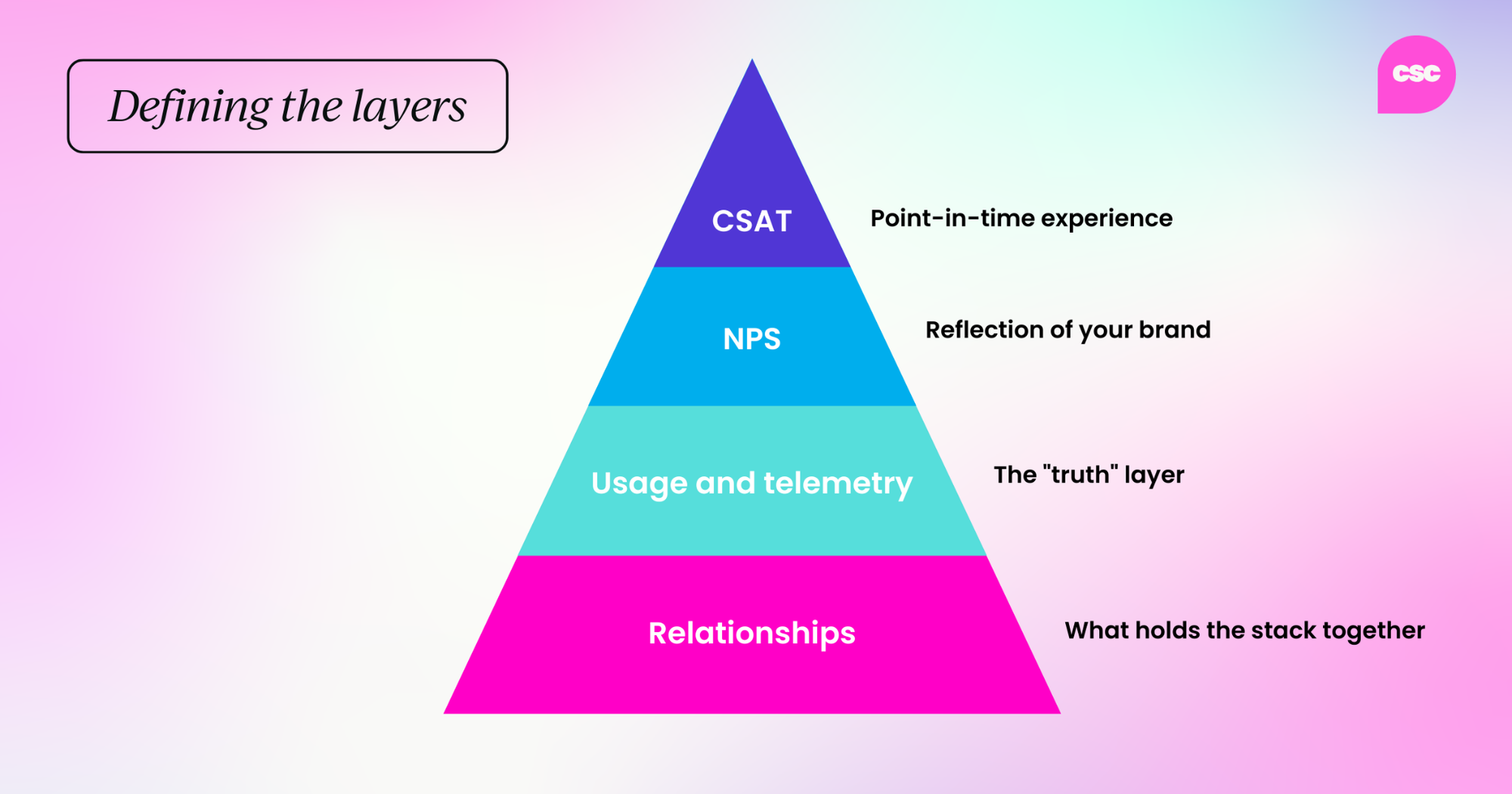
Defining the layers
- CSAT (customer satisfaction): This is your tactical, point-in-time experience. It's the feedback after a support ticket, a training session, or a new feature launch. It's great for real-time pulses, but it doesn't have much context.
- NPS (net promoter score): This is the reflection of your brand. It helps you find your detractors and your future fans. Today's team lead is tomorrow's budget holder; their brand perception now dictates your future renewals.
- Usage and telemetry: This is the "truth" layer. It's the data that shows whether people are actually using the product or if it's just shelfware.
- Relationships: This is what holds the stack together. In a market full of choices, the company that surrounds the customer with the best partnership wins.


Become a CSC Insider
Thank you for subscribing
Get exclusive insights, frameworks, and strategies from customer success leaders driving real business impact.
An email has been successfully sent to confirm your subscription.
 Follow us on LinkedIn